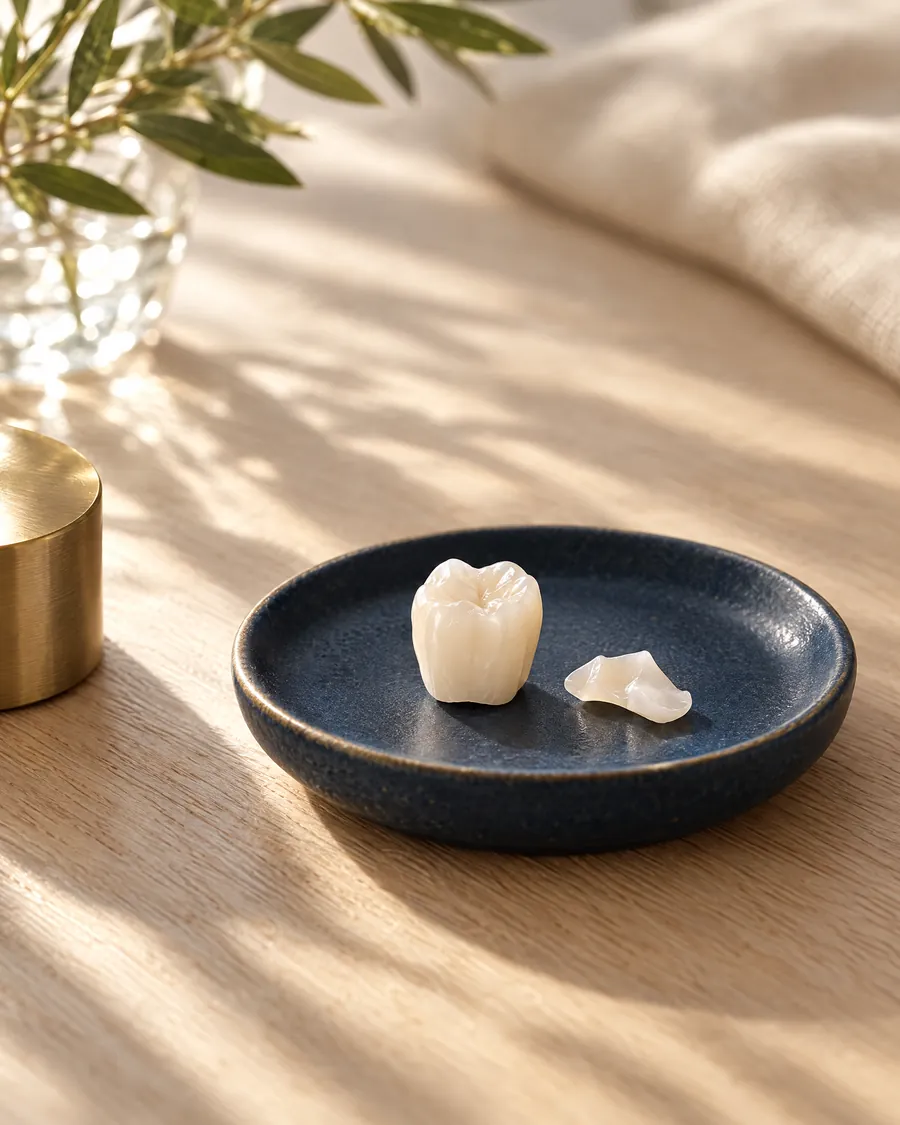
During root canal treatment, we remove the inflamed or dead tissue from inside the tooth, clean the fine root canals completely and seal them tightly. That way you keep your own tooth. The treatment is carried out under local anaesthetic: you feel touch, but no pain. Usually it takes one or two sessions. Afterwards we protect the tooth, often with a ceramic partial crown or crown, depending on how much tooth remains.
Updated: 9 November 2026
When root canal treatment makes sense
Inside every tooth lies the pulp, a fine tissue of nerves and blood vessels that reaches down to the tips of the roots. If bacteria get in, for example through deep decay, a crack or a leaking filling, it becomes inflamed. It can then no longer heal by itself.
Typical signs are a throbbing pain, often at night, a strong reaction to cold or heat that lingers for a long time, and pain when biting down. Sometimes the pulp dies without being noticed, and inflammation at the tip of the root only shows up on an X-ray.
The procedure, step by step
- Understand. We examine the tooth with digital X-rays and under the microscope. You receive a clear assessment of how well the tooth can be saved, and a written treatment plan.
- Numb. The treatment is carried out under local anaesthetic. You feel touch, but no pain, and we work at your pace.
- Isolate. A thin rubber sheet, the rubber dam, is placed around the tooth. It keeps saliva and bacteria away and protects you from the rinsing solutions.
- Clean. Through a small opening in the biting surface we reach the canals. Under up to 25-fold magnification we find them all, including the fine and hidden ones. With fine instruments and disinfecting rinsing solutions, we clean them down to the tip of the root.
- Seal. The canals are filled tightly and the tooth is sealed securely. If the inflammation is severe, we place a medication in the canals between two sessions so that it can heal.
- Protect. A tooth that has had root canal treatment is often weakened. So that it lasts, we protect it with a ceramic partial crown or crown, depending on how much tooth remains.
What the microscope changes
Root canals are fine, often branched and barely visible to the naked eye. If a canal is missed, bacteria remain there. Under up to 25-fold magnification we see fine canals, cracks and remnants of earlier fillings. What you can see, you can treat. For you, that means a thoroughly cleaned tooth that stays calm and lasts a long time. Dr. Dominika Kleinert-Baltsios has worked with the microscope since 2013, today with the Zeiss Extaro 300.
Does root canal treatment hurt?
Usually not. With local anaesthetic you feel touch, but no pain. Often the pain you came in with eases after the first session. If a tooth is severely inflamed, the anaesthetic sometimes takes longer to work. Then we top it up until you feel nothing.
In the days afterwards, the tooth may still be sensitive when you chew. What is normal then and what helps is explained in “Pain after a root canal: what is normal?”.
How long does root canal treatment take?
Usually one or two sessions of around 60 to 90 minutes each. For a retreatment, that is, treating a tooth that has already had root canal treatment again, or for severe inflammation, we plan more time. We set out the procedure for your tooth in the treatment plan.
How good is the outlook?
Around 9 out of 10 teeth are kept in the long term, after a first root canal treatment as well as after a retreatment. What makes the difference is complete cleaning of all canals, a tight seal and good protection of the tooth afterwards. We check the outlook for your tooth beforehand and discuss it openly with you.