As a rule, you can keep an intact amalgam filling. Replacing it is worth it if the filling has started to leak, the tooth shows cracks or you would like to be rid of the amalgam. Then we replace it with a tooth-coloured filling or with ceramic. We always work under a rubber dam, and you receive breathing protection. We do not use amalgam ourselves.
Updated: 9 November 2026
Is amalgam dangerous?
Amalgam contains mercury. According to scientific consensus, intact fillings are not considered a danger. The removal is the delicate part, because grinding the filling out releases mercury vapour. That is why we do not advise replacing healthy fillings as a precaution, and we protect you when we remove one.
In the EU, new amalgam fillings have been banned in principle since 1 January 2025. In November 2025, more than 150 countries also agreed to stop using amalgam by 2034. The aim is to bring less mercury into circulation. In Switzerland, amalgam is not banned, but it is now rarely used. For existing fillings this changes nothing: they can stay.
When replacing is worth it
Old amalgam fillings can encourage cracks in the tooth and start to leak over the years. Signs of this are:
- The edge of the filling is darkly discoloured, or decay has formed beneath the filling.
- The tooth shows fine cracks, or a cusp has broken off.
- The tooth is sensitive when chewing or to cold.
- You would rather not have metal in your mouth any more.
Whether this applies to you, we see at your dental check-up: under magnification and with digital X-rays where it clarifies something. You see everything on screen.
Filling or ceramic?
A filling is enough for small defects and small areas of decay. We build it up in layers from tooth-coloured composite and adjust it under magnification. You cannot see the filling, and you cannot feel it.
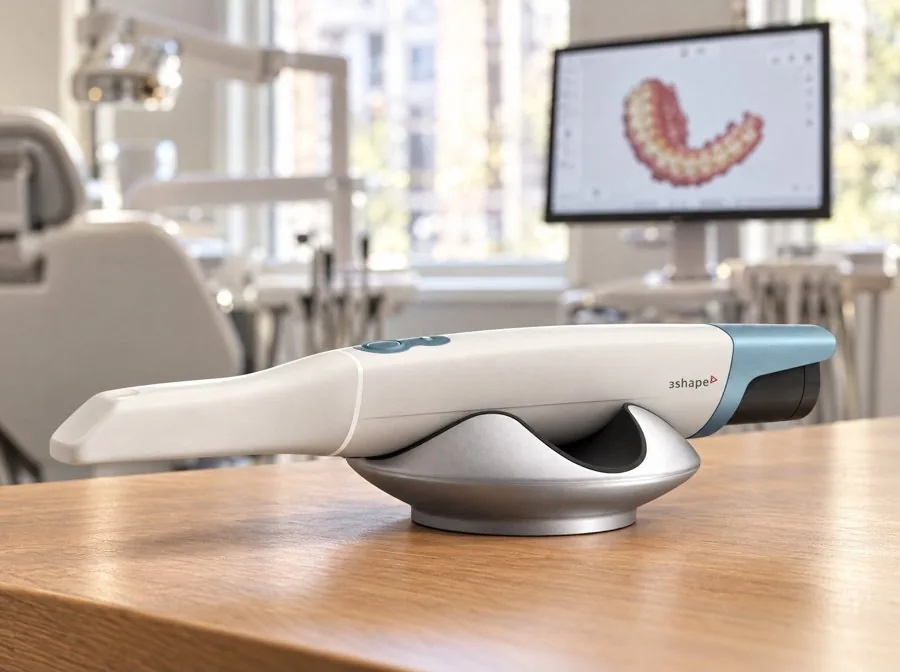
Old amalgam fillings are often large. Then ceramic is the better path: as an inlay, onlay or partial crown, for extensive defects, after root canal treatment and for weakened cusps. Ceramic looks like a natural tooth: in colour, translucency and surface. A digital scan replaces the impression, and an inlay usually takes two appointments.
How we protect you during removal
- Rubber dam: a thin rubber sheet is placed around the tooth and keeps fragments and vapour away from your mouth and throat.
- Breathing protection: you receive breathing protection for your nose.
- Powerful suction directly at the tooth, and we remove the filling in larger pieces where possible, rather than grinding it finely.
- Local anaesthetic: that way the removal is painless.
All at once or one by one?
That depends on how many fillings there are and what condition they are in. Usually we first replace the fillings that are leaking or put the tooth at risk, and plan the rest calmly. During pregnancy and breastfeeding, we do not replace intact amalgam fillings if it can be postponed.