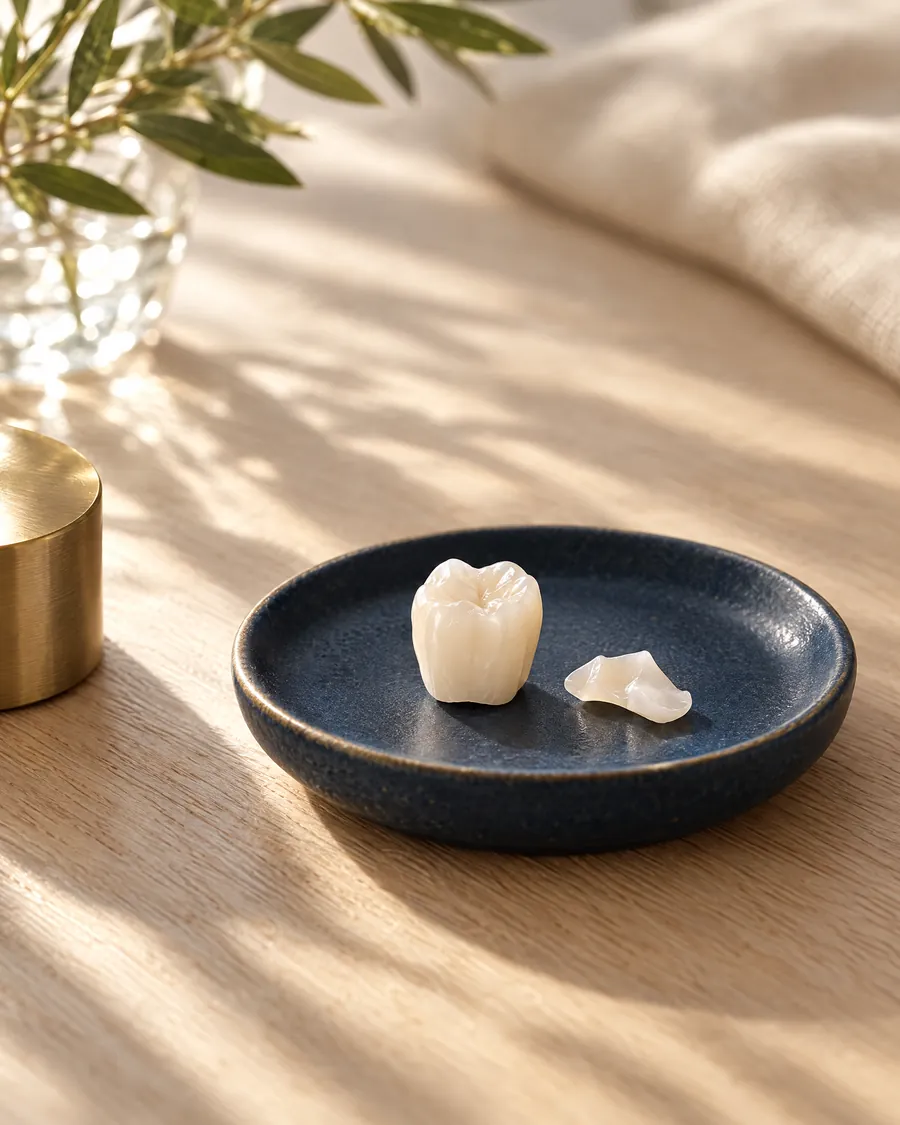
A tooth needs a crown when so much of its own structure is missing that a filling or an inlay can no longer hold it securely. That is often the case after extensive decay, with a broken cusp or with a back tooth after root canal treatment. As long as enough healthy tooth remains, a smaller restoration is often enough. We choose the smallest one that lasts.
Updated: 9 November 2026
From filling to crown
The more tooth structure is missing, the more the restoration takes over:
- Filling: closes a smaller defect directly in the tooth.
- Inlay: fills a larger defect within the tooth, individually made from ceramic.
- Partial crown: also replaces one or more cusps.
- Crown: covers the whole visible tooth.
A filling is enough for small defects and small areas of decay. We use ceramic for extensive defects, large areas of decay, after root canal treatment and for weakened cusps. Ceramic looks like a natural tooth: in colour, translucency and surface.
Typical reasons for a crown
- A large old filling around which the tooth is weakened or shows cracks.
- A broken cusp or a larger piece of tooth that is missing.
- A back tooth after root canal treatment: it is often heavily hollowed out, and a partial crown or crown protects it from breaking.
- An old crown that has started to leak or shows a dark line at the edge.
What you may notice yourself
Often nothing at all. Sometimes a tooth hurts briefly when you bite on a particular spot, or it reacts to cold. That can point to a crack. How weakened a tooth is shows up in the examination under magnification, with digital X-rays where it makes sense.
Why not go straight for a crown?
For a crown, the tooth is reshaped all the way round. What has been removed does not come back. That is why our approach is: preserve first, then replace, and only as much as is missing. Often an inlay or a partial crown is enough instead of a full crown.
How a ceramic crown is made
- Examine and plan: examination under magnification and with digital X-rays. You see on screen what we see and receive a written treatment plan.
- Prepare and scan: under local anaesthetic, carefully. A digital scan replaces the impression. If needed, a temporary crown protects the tooth.
- Fit and check: the ceramic is permanently attached, and we check your bite and the fit.
A crown usually takes two appointments.
How long does a ceramic crown last?
With good care and regular check-ups, usually many years, often ten years or longer. What matters is a tight edge, a balanced bite and care at home. If you grind at night, a splint protects the ceramic.