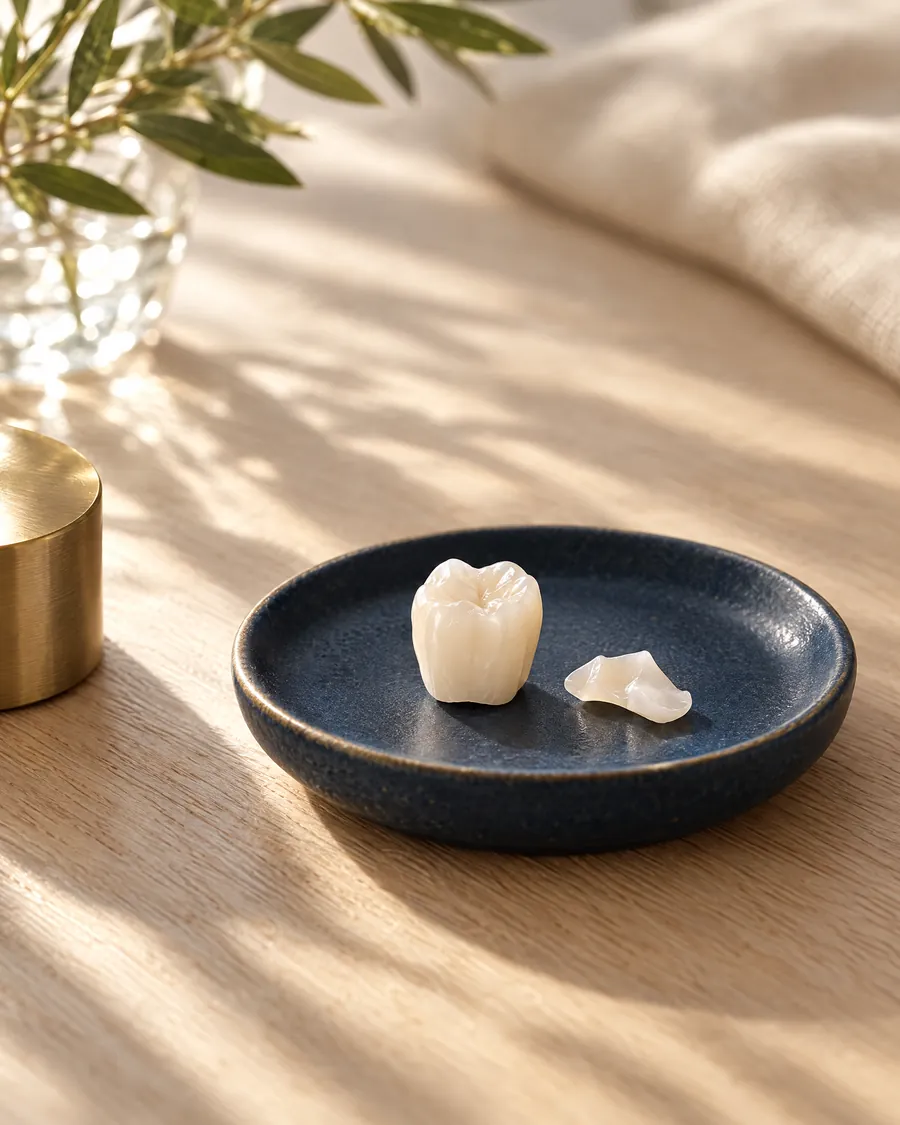
Both are precisely fitting ceramic inserts that are made in the laboratory and bonded into the tooth. An inlay sits between the cusps of the tooth. An onlay also covers one or more cusps. Which one fits depends only on how much healthy tooth is left.
Updated: 14 November 2026
At a glance
| Inlay | Onlay | Partial crown | |
|---|---|---|---|
| Replaces | the area between the cusps | plus one or more cusps | all cusps |
| Fits when | the cusps are stable | one cusp is weakened | the tooth needs protection all round |
That is how many ceramic restorations Dr. Dominika Kleinert-Baltsios places each year: inlays, onlays, crowns and bridges.
figure provided by the practiceWhen ceramic instead of a filling?
A filling is enough for small defects and small cavities. We use ceramic for extensive defects, large cavities, after a root canal treatment and for weakened cusps.
The procedure
Usually two appointments: at the first, we prepare the tooth, a digital scan replaces the impression, and you receive a temporary. At the second, the ceramic is bonded in and the bite is finely adjusted.
“Wouldn't a filling be enough?”
Often, yes. We will tell you if that is the case. With a large defect, a filling carries the chewing forces less well over time, and the tooth can crack.
What your tooth needs, we set out in writing in the treatment plan.
Book a consultation and treatment plan